Fundess GmbH
Thierschstrasse 14
80538 Munich, Germany



Fundess GmbH
Thierschstrasse 14
80538 Munich, Germany
The Next Evolution in Corporate Banking: Intelligently Integrating Funding and Financing
Guest Commentary in Handelsblatt Live Dr. Rosi Hermann, MBA, CEO, Fundess GmbH | October 7, 2026
The German economy faces a historic transformation challenge. Digitalisation, automation, artificial intelligence, decarbonisation and the development of new business models require investments running into billions. For many companies, the greatest challenge is not the strategic need to innovate, but how to finance that innovation. Yet in practice, funding opportunities and financing structures are still often considered separately. Funding programmes are frequently assessed only after financing arrangements are already in place, leaving significant potential untapped.
The future of corporate banking lies not in treating lending and public funding as separate instruments, but in intelligently integrating the two. Banks have a decisive advantage thanks to their close relationships with corporate clients: they are often involved in investment and transformation projects at a very early stage. This puts them in a position to identify funding opportunities before the financing structure is finalised. By integrating funding considerations into advisory services from the outset, banks can develop better financing solutions for their clients while also strengthening the quality of their own credit decisions.

Integrating Public Funding into Modern Credit Processes
The credit processes of the future will no longer begin with the question of which financing instrument to use. Instead, they will start with an analysis of all available sources of capital. To this end, a key question should be embedded in the needs assessment from the outset:
“Which elements of the project could qualify for support through public funding instruments?”
This approach establishes a structured three-step process:
1. Analysis of the investment and innovation project
2. Identification of eligible activities
3. Optimisation of the overall financing structure
Public funding is thus no longer treated as an afterthought in the form of a supplementary grant, but as a strategic component of the financing solution. The result is more efficient use of capital, additional liquidity and enhanced investment capacity for businesses.
The Research Tax Incentive: A New Component of Innovation Financing
The research tax incentive is particularly relevant in this context. Unlike traditional funding programmes, it is technology-neutral, available across industries and permanently accessible. Companies can receive tax-based support for research, development and certain investments without having to rely on topic-specific funding calls. This creates a predictable source of liquidity that has a direct bearing on financing decisions.
For banks, this opens up new opportunities to assess and structure innovation projects:
– Additional liquidity to finance growth
– An improved capital structure
– Greater capacity for self-financing
– More stable future cash flows
– Reduced financing risk
– Greater corporate willingness to invest
The research tax incentive is therefore increasingly evolving from a tax-based support mechanism into a key component of modern innovation financing.
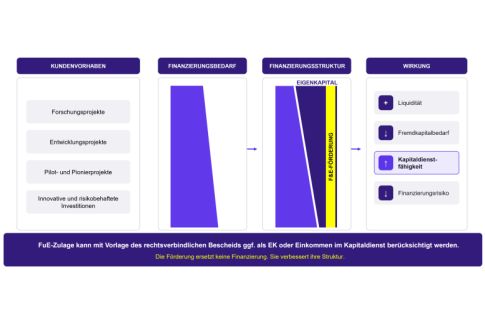
Figure 1: Integrating Funding and Financing. By incorporating public funding instruments into the financing structure at an early stage, an additional source of capital can be leveraged to enhance liquidity, investment capacity and the creditworthiness of innovation projects. This enables banks to evolve from traditional lenders into strategic innovation partners.
From Capital Provider to Innovation Partner
Institutions that systematically integrate public funding and financing create value for all stakeholders. Businesses gain access to additional sources of capital and can implement investments more quickly. Banks strengthen their position as strategic advisers, deepen client relationships and improve the risk profile of their financing portfolios. Savings banks and cooperative banks, in particular, can further expand their role as regional innovation partners. They do more than finance corporate transformation; they actively enable innovation.
This gives rise to a new model of corporate banking:
The focus shifts from financing individual projects to providing holistic support for growth, transformation and innovation. By integrating public funding into credit processes at an early stage, banks can create more effective financing structures, reduce risk and sustainably strengthen the competitiveness of Germany’s small and medium-sized enterprises (SMEs).